
Voriconazole N-Oxide
A summary of the most common chemical descriptors (InChI Key and SMILES codes) for Voriconazole N-Oxide are summarized together with 3D and 2D structures and relevant physico-chemical properties.
Table of Contents
What is the Voriconazole N-Oxide?
The molecule Voriconazole N-Oxide presents a molecular formula of C16H14F3N5O2 and its IUPAC name is (2R,3S)-2-(2,4-difluorophenyl)-3-(5-fluoro-1-oxidopyrimidin-1-ium-4-yl)-1-(1,2,4-triazol-1-yl)butan-2-ol.
Voriconazole N-Oxide is a molecule used in the treatment of fungal infections. It is a derivative of the anti-fungal drug voriconazole and is used to treat infections caused by Candida, Aspergillus, and Scedosporium species of fungi. Voriconazole N-Oxide is a prodrug of voriconazole and is converted to voriconazole in the body. The prodrug is more stable in the body and has a longer half-life than voriconazole. Voriconazole N-Oxide exists as a tablet and an intravenous (IV) formulation. The IV formulation is used for the treatment of serious fungal infections, such as those that have spread to the blood or organs..
3D structure
Cartesian coordinates
Geometry of Voriconazole N-Oxide in x, y and z coordinates (Å units) to copy/paste elsewhere. Generated with Open Babel software.
2D drawing
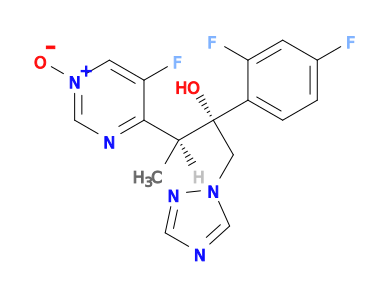
Molecule descriptors
| IUPAC name | (2R,3S)-2-(2,4-difluorophenyl)-3-(5-fluoro-1-oxidopyrimidin-1-ium-4-yl)-1-(1,2,4-triazol-1-yl)butan-2-ol |
| InChI code | InChI=1S/C16H14F3N5O2/c1-10(15-14(19)5-24(26)9-21-15)16(25,6-23-8-20-7-22-23)12-3-2-11(17)4-13(12)18/h2-5,7-10,25H,6H2,1H3/t10-,16+/m0/s1 |
| InChI Key | KPLFPLUCFPRUHU-MGPLVRAMSA-N |
| SMILES | C[C@@H](c1nc[n+]([O-])cc1F)[C@](O)(Cn1cncn1)c1ccc(F)cc1F |
Other names (synonyms)
IUPAC nomenclature provides a standardized method for naming chemical compounds. Although this system is widely used in chemistry, many chemical compounds have also other names commonly used in different contexts. These synonyms can come from a variety of sources and are used for a variety of purposes.
One common source of synonyms for chemical compounds is the common or trivial names, assigned on the basis of appearance, properties, or origin of the molecule.
Another source of synonyms are historical or obsolete names employed in the past, however replaced nowadays by more modern or standardized names.
In addition to common and historical names, chemical compounds may also have synonyms that are specific to a particular field or industry.
- (2R,3S)-2-(2,4-difluorophenyl)-3-(5-fluoro-1-oxidopyrimidin-1-ium-4-yl)-1-(1,2,4-triazol-1-yl)butan-2-ol
- (2R,3S)-2-(2,4-diluorophenyl)-3-(5-luoro-1-oxidopyrimidin-1-ium-4-yl)-1-(1,2,4-triazol-1-yl)butan-2-ol
- 4-((2S,3R)-3-(2,4-difluorophenyl)-3-hydroxy-4-(1H-1,2,4-triazol-1-yl)butan-2-yl)-5-fluoropyrimidine 1-oxide
- 4-PYRIMIDINEETHANOL, .ALPHA.-(2,4-DIFLUOROPHENYL)-5-FLUORO-.BETA.-METHYL-.ALPHA.-(1H-1,2,4-TRIAZOL-1-YLMETHYL)-, 1-OXIDE, (.ALPHA.R,.BETA.S)-
- 4-Pyrimidineethanol, alpha-(2,4-difluorophenyl)-5-fluoro-beta-methyl-alpha-(1H-1,2,4-triazol-1-ylmethyl)-, 1-oxide, (alphaR,betaS)-
- 4-[(2S,3R)-3-(2,4-Difluorophenyl)-3-hydroxy-4-(1H-1,2,4-triazol-1-yl)butan-2-yl]-5-fluoropyrimidin-1-ium-1-olate
- 618109-05-0
- 684933R4SK
- Q27264211
- UK 121265
- UK-121,265
- UK-121265
- Voriconazole N-Oxide
Reference codes for other databases
There exist several different chemical codes commonly used in orded to identify molecules:- CAS number (Chemical Abstracts Service Registry Number) is a unique identifier is assigned to every chemical compound indexed in the CAS database.
- Beilstein: The Beilstein database is a comprehensive source of information on organic chemistry, including information on chemical structures, properties, and reactions. The Beilstein database assigns unique identifiers which can be used to identify compounds in scientific literature and other sources.
- ChEBI (Chemical Entities of Biological Interest): ChEBI is a database of small chemical molecules that are of interest in the field of biology.
- PubChem CID (Compound Identifier): PubChem is a database of chemical compounds that is maintained by the National Institutes of Health (NIH).
- RTECS number (Registry of Toxic Effects of Chemical Substances): The RTECS is a database of information on the toxic effects of chemicals, including information on their structures and properties.
- ChEMBL (Compound Bioactivity Data): ChEMBL is a database of bioactivity data for small molecules, including information on their properties and structures.
- CompTox Dashboard (Environmental Protection Agency): The CompTox Dashboard is a database of information on the toxicology and environmental effects of chemicals.
- ZINC22067493
- UNII-684933R4SK
- AKOS025394780
- DTXSID90434719
- CHEBI:175687
- SCHEMBL15879291
Physico-Chemical properties
| IUPAC name | (2R,3S)-2-(2,4-difluorophenyl)-3-(5-fluoro-1-oxidopyrimidin-1-ium-4-yl)-1-(1,2,4-triazol-1-yl)butan-2-ol |
| Molecular formula | C16H14F3N5O2 |
| Molecular weight | 365.31 |
| Melting point (ºC) | |
| Boiling point (ºC) | |
| Density (g/cm3) | |
| Molar refractivity | 84.55 |
| LogP | 2.2 |
| Topological polar surface area | 89.3 |
LogP and topological polar surface area (TPSA) values were estimated using Open Babel software.
The n-octanol/water partition coeficient (Kow) data is applied in toxicology and drug research. Kow values are used, to guess the environmental fate of persistent organic pollutants. High partition coefficients values, tend to accumulate in the fatty tissue of organisms. Molecules with a log(Kow) (or LogP) greater than 5 are considered to bioaccumulate.
TPSA values are the sum of the surface area over all polar atoms or molecules, mainly oxygen and nitrogen, also including hydrogen atoms.
In medicinal chemistry, TPSA is used to assess the ability of a drug to permeabilise cells.
For molecules to penetrate the blood-brain barrier (and act on receptors in the central nervous system), TPSA values below 90 Å2 are required. Thus, molecules with a polar surface area greater than 140 Å2 tend to be poorly permeable to cell membranes.