
Citric Acid
A summary of the most common chemical descriptors (InChI Key and SMILES codes) for Citric Acid are summarized together with 3D and 2D structures and relevant physico-chemical properties.
Table of Contents
What is the Citric Acid?
The molecule Citric Acid presents a molecular formula of C6H8O7 and its IUPAC name is 2-hydroxypropane-1,2,3-tricarboxylic acid.
Citric acid is a weak organic acid that has the chemical formula C6H8O7. It occurs naturally in citrus fruits. In biochemistry, it is an important intermediate in the citric acid cycle, which occurs in the metabolism of all aerobic organisms. More than a million tons of citric acid are manufactured every year. It is used as an acidulant, as a flavoring and chelating agent..
Citric acid exists in a variety of fruits and vegetables, but it is especially concentrated in lemons and limes, where it can comprise as much as 8% of the dry weight of the fruit. The concentrations of citric acid in citrus fruits vary depending on the species and the particular fruit. For example, citric acid is present in relatively high concentrations in lemons (about 5.5 g/L) and limes (about 3.5 g/L), but it is present in only trace amounts in oranges and grapefruits..
Citric acid was first isolated in 1784 by the Swedish chemist Carl Wilhelm Scheele, who found it in lemon juice. However, it was not until 1834 that the German chemist Justus von Liebig determined that citric acid was the active ingredient in lemon juice..
Citric acid is a tribasic acid, meaning that it has three hydroxyl groups that can each donate a hydrogen ion (H+). When all three groups are ionized, the resulting compound is known as trisodium citrate, which is a common ingredient in detergents and cleaners..
The acidity of citric acid (pKa = 3.13) is intermediate between that of acetic acid (pKa = 4.76) and that of hydrochloric acid (pKa = -6.00). The pH of a 0.1 molar solution of citric acid is 2.87..
Citric acid can be used as an acidulant in food and beverage applications, where it provides a sour taste. It is also used as a chelating agent, binding to metal ions and preventing them from interacting with other molecules. In addition, citric acid is used as a cleaning agent, a descaling agent, and an ingredient in cosmetics and personal care products..
Citric acid is produced on a large scale by the fermentation of sugar. The most common microorganisms used for this purpose are Aspergillus niger and A. awamori. However, other microorganisms, such as Candida sp. and Kluyveromyces sp., can also be used..
The fermentation process begins with the hydrolysis of sucrose or glucose to form citric acid. The citric acid is then isolated and purified by a series of steps, including crystallization, decolorization, and ion exchange..
The global demand for citric acid is expected to continue to grow in the future, driven by the increasing popularity of healthy and natural foods and beverages. In addition, the expanding cosmetics and personal care industry is expected to provide a boost to the citric acid market..
3D structure
Cartesian coordinates
Geometry of Citric Acid in x, y and z coordinates (Å units) to copy/paste elsewhere. Generated with Open Babel software.
2D drawing
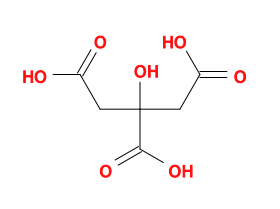
Molecule descriptors
| IUPAC name | 2-hydroxypropane-1,2,3-tricarboxylic acid |
| InChI code | InChI=1S/C6H8O7/c7-3(8)1-6(13,5(11)12)2-4(9)10/h13H,1-2H2,(H,7,8)(H,9,10)(H,11,12) |
| InChI Key | KRKNYBCHXYNGOX-UHFFFAOYSA-N |
| SMILES | O=C(O)CC(O)(CC(=O)O)C(=O)O |
Other names (synonyms)
IUPAC nomenclature provides a standardized method for naming chemical compounds. Although this system is widely used in chemistry, many chemical compounds have also other names commonly used in different contexts. These synonyms can come from a variety of sources and are used for a variety of purposes.
One common source of synonyms for chemical compounds is the common or trivial names, assigned on the basis of appearance, properties, or origin of the molecule.
Another source of synonyms are historical or obsolete names employed in the past, however replaced nowadays by more modern or standardized names.
In addition to common and historical names, chemical compounds may also have synonyms that are specific to a particular field or industry.
- .beta.-Hydroxytricarballylic acid
- 1,2,3-PROPANETRICARBOXYLIC ACID,2-HYDROXY (CITRIC ACID)
- 1,2,3-Propanetricarboxylic acid, 2-hydroxy-
- 1,2,3-Propanetricarboxylic acid, 2-hydroxy- (9CI)
- 1,2,3-Propanetricarboxylic acid, 2-hydroxy-, homopolymer
- 1,3-Propanetricarboxylic acid, 2-hydroxy-
- 10402-15-0
- 141633-96-7
- 1i2s
- 1o4l
- 1rq2
- 1y4a
- 2-Hydroxy-1,2,3-propane tricarboxylic acid
- 2-Hydroxy-1,2,3-propanenetricarboxylic acid
- 2-Hydroxy-1,3-propanetricarboxylic acid
- 2-Hydroxypropanetricarboxylic acid
- 2-Hydroxytricarballylic acid
- 2-hydroxy-1,2,3-propanetricarboxyic acid
- 2-hydroxy-1,2,3-propanetricarboxylate
- 2-hydroxy-1,2,3-propanetricarboxylic acid
- 2-hydroxypropane-1,2,3-tricarboxylic acid
- 2-hydroxypropane-1,2,3-tricarboxylicacid
- 2bo4
- 2c4v
- 2fw6
- 2fwp
- 3-Carboxy-3-hydroxypentane-1,5-dioate
- 3-Carboxy-3-hydroxypentane-1,5-dioic acid
- 4aci
- 4nrm
- 4o61
- 4to8
- 77-92-9
- 8F5D336A-442D-434A-9FB0-E400FF74E343
- AE-562/40806920
- AI3-06286
- ANHYDROUS CITRIC ACID COMPONENT OF CLENPIQ
- Acidum citricum
- Acidum citricum monohydrate
- Aciletten
- Anhydrous citrate
- Anhydrous citric acid
- Anhydrous citric acid (JP17)
- B7297
- BBL002530
- BDBM14672
- BP-31028
- BRN 0782061
- BSPBio_003240
- C00158
- C1949
- CCRIS 3292
- CITRATE ANION
- CLENPIQ COMPONENT ANHYDROUS CITRIC ACID
- CS-6965
- Caswell No. 221C
- Citraclean
- Citretten
- Citric Acid
- Citric Acid (Anhydrous)
- Citric Acid, anhydrous granular, A.C.S.
- Citric Acid, anhydrous powder, A.C.S.
- Citric Acid, anhydrous, USP
- Citric Acid,(S)
- Citric acid (8CI)
- Citric acid (monohydrate): H2O = 1 g : 1 ml solution
- Citric acid anhydrous
- Citric acid anhydrous (JAN)
- Citric acid bp
- Citric acid monoglyceride
- Citric acid, anhydrous
- Citric acid, anhydrous, cell culture tested, plant cell culture tested
- Citric acid, hydrous
- Citric acid, meets USP testing specifications, anhydrous
- Citric acid,anhydrous
- Citric acid,hydrous
- Citric acid-[13C6]
- Citricum acidum
- Citro
- Citronensaeure
- Chemfill
- D00037
- DB04272
- DSSTox_CID_332
- DSSTox_GSID_20332
- DSSTox_RID_75520
- E 330
- E-330
- E330
- EC 201-069-1
- EPA Pesticide Chemical Code 021801
- F 0001 (polycarboxylic acid)
- F2191-0222
- FEMA No. 2306
- FEMA Number 2306
- FT-0623957
- FT-0665073
- FT-0728530
- GTPL2478
- H3cit
- HMS1787N01
- HMS2268B04
- HOC(CH2COOH)2COOH
- HSDB 911
- HY-N1428
- Hydrocerol A
- INS NO.330
- INS-330
- J-520099
- K-Lyte
- K-Lyte DS
- KBio3_002740
- Kyselina 2-hydroxy-1,2,3-propantrikarbonova
- Kyselina citronova
- MFCD00011669
- MLS001066346
- NCGC00090954-01
- NCGC00090954-02
- NCGC00090954-03
- NCGC00090954-04
- NCGC00090954-05
- NCGC00254055-01
- NCGC00259954-01
- NCI60_022579
- NCIOpen2_004062
- NCIOpen2_004502
- NCIStruc1_000057
- NCIStruc2_000099
- NSC 30279
- NSC 626579
- NSC-112226
- NSC-30279
- NSC-626579
- NSC30279
- NSC626579
- NSC759606
- Oprea1_502996
- Pharmakon1600-01300013
- Poly(oxy-1,2-ethanediyl), .alpha.-phosphono-.omega.-hydroxy-, C14-18-alkyl ethers
- Q159683
- SBI-0206765.P001
- SMR000471840
- STK286098
- STR12052
- Suby G
- Uro-trainer
- WLN: QV1XQVQ1VQ
- XF417D3PSL
- Z56754862
- beta-Hydroxytricarballylate
- beta-Hydroxytricarballylic acid
- bmse000076
- cid_311
- citr
- citric acid
- citric-acid
- s5761
Reference codes for other databases
There exist several different chemical codes commonly used in orded to identify molecules:- CAS number (Chemical Abstracts Service Registry Number) is a unique identifier is assigned to every chemical compound indexed in the CAS database.
- Beilstein: The Beilstein database is a comprehensive source of information on organic chemistry, including information on chemical structures, properties, and reactions. The Beilstein database assigns unique identifiers which can be used to identify compounds in scientific literature and other sources.
- ChEBI (Chemical Entities of Biological Interest): ChEBI is a database of small chemical molecules that are of interest in the field of biology.
- PubChem CID (Compound Identifier): PubChem is a database of chemical compounds that is maintained by the National Institutes of Health (NIH).
- RTECS number (Registry of Toxic Effects of Chemical Substances): The RTECS is a database of information on the toxic effects of chemicals, including information on their structures and properties.
- ChEMBL (Compound Bioactivity Data): ChEMBL is a database of bioactivity data for small molecules, including information on their properties and structures.
- CompTox Dashboard (Environmental Protection Agency): The CompTox Dashboard is a database of information on the toxicology and environmental effects of chemicals.
- ZINC895081
- CAS-77-92-9
- UNII-XF417D3PSL
- AKOS000119911
- DTXSID3020332
- CHEMBL1261
- CHEBI:30769
- Tox21_113436
- Tox21_202405
- Tox21_300124
- EINECS 201-069-1
- Spectrum3_001850
Physico-Chemical properties
| IUPAC name | 2-hydroxypropane-1,2,3-tricarboxylic acid |
| Molecular formula | C6H8O7 |
| Molecular weight | 192.124 |
| Melting point (ºC) | |
| Boiling point (ºC) | |
| Density (g/cm3) | |
| Molar refractivity | 37.47 |
| LogP | -1.2 |
| Topological polar surface area | 132.1 |
LogP and topological polar surface area (TPSA) values were estimated using Open Babel software.
The n-octanol/water partition coeficient (Kow) data is applied in toxicology and drug research. Kow values are used, to guess the environmental fate of persistent organic pollutants. High partition coefficients values, tend to accumulate in the fatty tissue of organisms. Molecules with a log(Kow) (or LogP) greater than 5 are considered to bioaccumulate.
TPSA values are the sum of the surface area over all polar atoms or molecules, mainly oxygen and nitrogen, also including hydrogen atoms.
In medicinal chemistry, TPSA is used to assess the ability of a drug to permeabilise cells.
For molecules to penetrate the blood-brain barrier (and act on receptors in the central nervous system), TPSA values below 90 Å2 are required. Thus, molecules with a polar surface area greater than 140 Å2 tend to be poorly permeable to cell membranes.