
Ticagrelor
A summary of the most common chemical descriptors (InChI Key and SMILES codes) for Ticagrelor are summarized together with 3D and 2D structures and relevant physico-chemical properties.
Table of Contents
What is the Ticagrelor?
The molecule Ticagrelor presents a molecular formula of C23H28F2N6O4S and its IUPAC name is (1S,2S,3R,5S)-3-[7-[[(1R,2S)-2-(3,4-difluorophenyl)cyclopropyl]amino]-5-propylsulfanyltriazolo[4,5-d]pyrimidin-3-yl]-5-(2-hydroxyethoxy)cyclopentane-1,2-diol.
Ticagrelor (Brilinta) is a medication used to prevent blood clots. It is an antiplatelet medication. That means it works by keeping your blood from clotting..
Ticagrelor is used to prevent heart attacks and strokes in people with heart disease. It is also used in people who have had a heart attack or stroke..
Ticagrelor is usually taken with aspirin..
Take ticagrelor exactly as prescribed by your doctor. Do not take it in larger or smaller amounts or for longer than recommended..
Your doctor may prescribe a different aspirin dose for you to take with ticagrelor. Follow your doctor's instructions..
You may need to stop taking ticagrelor for a short time before having surgery or other medical procedures. Stopping suddenly could increase your risk of having a heart attack or stroke..
If you cannot swallow a tablet, ask your doctor or pharmacist about other ways to take ticagrelor..
Ticagrelor is usually taken twice per day. Take the medicine at the same time each day..
Do not crush, chew, or break a ticagrelor tablet. Swallow it whole..
While taking ticagrelor, you may bruise or bleed more easily. Be careful not to cut yourself when you are using sharp objects such as a razor or nail clippers..
Do not take aspirin unless your doctor tells you to..
If you have a heart attack or stroke, ticagrelor may help keep your blood from clotting. This can help you recover from your heart attack or stroke..
If you take ticagrelor, you may have bleeding that is serious and sometimes fatal. This type of bleeding may happen in your brain, stomach, or intestines. You may have a higher risk of bleeding if you take ticagrelor and aspirin..
Call your doctor or get medical help right away if you have any of these signs or symptoms of bleeding:.
bleeding from a cut that takes a long time to stop.
bleeding from your gums.
unusual bleeding from your nose or vagina.
menstrual bleeding that is heavier than normal or lasts longer than usual.
pink or brown urine.
red or black stools that look like tar.
coughing up or vomiting blood or coffee ground-like material.
dizziness, weakness, or confusion.
headache, trouble speaking, or change in vision.
Ticagrelor can cause side effects. Tell your doctor if any of these symptoms are severe or do not go away:.
headache.
diarrhea.
nausea.
vomiting.
stomach pain.
gas.
dizziness.
tiredness.
rash.
Ticagrelor may cause other side effects. Call your doctor if you have any unusual problems while taking this medication..
If you experience a serious side effect, you or your doctor may send a report to the Food and Drug Administration's (FDA) MedWatch Adverse Event Reporting program online (http://www.fda.gov/Safety/MedWatch) or by phone (1-800-332-1088)..
3D structure
Cartesian coordinates
Geometry of Ticagrelor in x, y and z coordinates (Å units) to copy/paste elsewhere. Generated with Open Babel software.
2D drawing
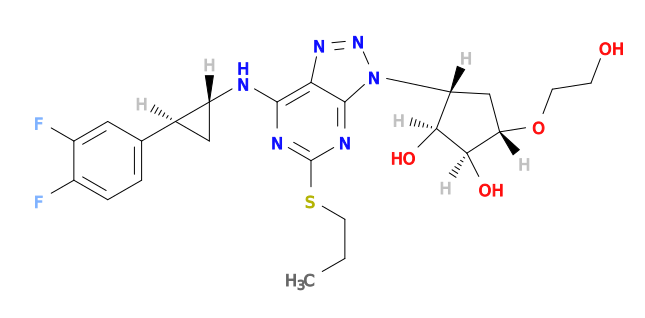
Molecule descriptors
| IUPAC name | (1S,2S,3R,5S)-3-[7-[[(1R,2S)-2-(3,4-difluorophenyl)cyclopropyl]amino]-5-propylsulfanyltriazolo[4,5-d]pyrimidin-3-yl]-5-(2-hydroxyethoxy)cyclopentane-1,2-diol |
| InChI code | InChI=1S/C23H28F2N6O4S/c1-2-7-36-23-27-21(26-15-9-12(15)11-3-4-13(24)14(25)8-11)18-22(28-23)31(30-29-18)16-10-17(35-6-5-32)20(34)19(16)33/h3-4,8,12,15-17,19-20,32-34H,2,5-7,9-10H2,1H3,(H,26,27,28)/t12-,15+,16+,17-,19-,20+/m0/s1 |
| InChI Key | OEKWJQXRCDYSHL-FNOIDJSQSA-N |
| SMILES | CCCSc1nc(N[C@@H]2C[C@H]2c2ccc(F)c(F)c2)c2nnn([C@@H]3C[C@H](OCCO)[C@@H](O)[C@H]3O)c2n1 |
Other names (synonyms)
IUPAC nomenclature provides a standardized method for naming chemical compounds. Although this system is widely used in chemistry, many chemical compounds have also other names commonly used in different contexts. These synonyms can come from a variety of sources and are used for a variety of purposes.
One common source of synonyms for chemical compounds is the common or trivial names, assigned on the basis of appearance, properties, or origin of the molecule.
Another source of synonyms are historical or obsolete names employed in the past, however replaced nowadays by more modern or standardized names.
In addition to common and historical names, chemical compounds may also have synonyms that are specific to a particular field or industry.
- (1S,2S,3R,5S)-3-(7-(((1R)-2-(3,4-Difluorophenyl)cyclopropyl)amino)-5-(propylthio)-3H-[1,2,3]triazolo[4,5-d]pyrimidin-3-yl)-5-(2-hydroxyethoxy)cyclopentane-1,2-diol
- (1S,2S,3R,5S)-3-(7-(((1R,2S)-2-(3,4-difluorophenyl)cyclopropyl)amino)-5-(propylthio)-3H-[1,2,3]triazolo[4,5-d]pyrimidin-3-yl)-5-(2-hydroxyethoxy)cyclopentane-1,2-diol
- (1S,2S,3R,5S)-3-(7-(((1S,2S)-2-(3,4-difluorophenyl)cyclopropyl)aMino)-5-(propylthio)-3H-[1,2,3]triazolo[4,5-d]pyriMidin-3-yl)-5-(2-hydroxyethoxy)cyclopentane-1,2-diol
- (1S,2S,3R,5S)-3-(7-((1R,2S)-2-(3,4-Difluorophenyl)cyclopropylamino)-5-(propylthio)-3H-(1,2,3)triazolo(4,5-d)pyrimidin-3-yl)-5-(2-hydroxyethoxy)cyclopentane-1,2-diol
- (1S,2S,3R,5S)-3-(7-((1R,2S)-2-(3,4-difluorophenyl)cyclopropylamino)-5-(propylthio)-3H-[1,2,3]triazolo[4,5-d]pyrimidin-3-yl)-5-(2-hydroxyethoxy) cyclopentane-1,2-diol
- (1S,2S,3R,5S)-3-(7-((1R,2S)-2-(3,4-difluorophenyl)cyclopropylamino)-5-(propylthio)-3H-[1,2,3]triazolo[4,5-d]pyrimidin-3-yl)-5-(2-hydroxyethoxy)cyclopentane-1,2 diol
- (1S,2S,3R,5S)-3-(7-((1R,2S)-2-(3,4-difluorophenyl)cyclopropylamino)-5-(propylthio)-3H-[1,2,3]triazolo[4,5-d]pyrimidin-3-yl)-5-(2-hydroxyethoxy)cyclopentane-1,2-diol
- (1S,2S,3R,5S)-3-(7-{[(1R,2S)-2-(3,4-difluorophenyl)cyclopropyl]amino}-5-(propylsulfanyl)-3H-[1,2,3]triazolo[4,5-d]pyrimidin-3-yl)-5-(2-hydroxyethoxy)cyclopentane-1,2-diol
- (1S,2S,3R,5S)-3-[7-[(1R,2S)-2-(3,4-Difluorophenyl)cyclopropylamino]-5-(propylthio)- 3H-[1,2,3]triazolo[4,5-d]pyrimidin-3-yl]-5-(2-hydroxyethoxy)cyclopentane-1,2-diol
- (1S,2S,3R,5S)-3-[7-[[(1R,2S)-2-(3,4-DIFLUOROPHENYL)CYCLOPROPYL]AMINO]-5-(PROPYLTHIO)-3H-1,2,3-TRIAZOLO[4,5-D]PYRIMIDIN-3-YL]-5-(2-HYDROXYETHOXY)-1,2-CYCLOPENTANEDIOL
- (1S,2S,3R,5S)-3-[7-[[(1R,2S)-2-(3,4-Difluorophenyl)cyclopropyl]amino]-5-(propylthio)-3H-[1,2,3]triazolo[4,5-d]pyrimidin-3-yl]-5-(2-hydroxyethoxy)cyclopentane-1,2-diol
- (1S,2S,3R,5S)-3-[7-[[(1R,2S)-2-(3,4-difluorophenyl)cyclopropyl]amino]-5-propylsulfanyltriazolo[4,5-d]pyrimidin-3-yl]-5-(2-hydroxyethoxy)cyclopentane-1,2-diol
- (1S,2S,3R,5S)-3-[7-[[(1R,2S)-2-(3,4-difluorophenyl)cyclopropyl]amino]-5-propylsulfanyltriazolo[5,4-d]pyrimidin-3-yl]-5-(2-hydroxyethoxy)cyclopentane-1,2-diol
- (1S,2S,3R,5S)-3-[7-{[(1R,2S)-2-(3,4-difluorophenyl)cyclopropyl]amino}-5-(propylsulfanyl)-3H-[1,2,3]triazolo[4,5-d]pyrimidin-3-yl]-5-(2-hydroxyethoxy)cyclopentane-1,2-diol
- (1s,2s,3r,5s)-3-[7-[[(1r,2s)-2-(3,4-difluorophenyl)-cyclopropyl]amino]-5-(propylthio)-3h-[1,2,3]-triazolo[4,5-d]pyrimidine-3-yl]-5-(2-hydroxyethoxy) cyclopentane-1,2-diol
- 1,2-Cyclopentanediol, 3-(7-(((1R,2S)-2-(3,4-difluorophenyl)cyclopropyl)amino)-5-(propylthio)-3H-1,2,3-triazolo(4,5-d)pyrimidin-3-yl)-5-(2-hydroxyethoxy)-, (1S,2S,3R,5S)-
- 1,2-Cyclopentanediol,3-[7-[[(1R,2S)-2-(3,4-difluorophenyl)cyclopropyl]amino]-5-(propylthio)-3H-1,2,3-triazolo[4,5-d]pyrimidin-3-yl]-5-(2-hydroxyethoxy)-,(1S,2S,3R,5S)-
- 274693-27-5
- 693T275
- A850981
- AB01565855_02
- AC-24755
- AM85693
- AMMD00027
- AR-C 126532XX
- AR-C 126532XX;AZD6140
- AR-C126532
- AR-C126532XX
- AS-19943
- AZD 6140
- AZD-6140
- AZD6140
- BDBM50397205
- BT164470
- Brilinta
- Brilique
- C23H28F2N6O4S
- CCG-269870
- CS-0619
- D09017
- DB08816
- EX-6274
- EX-A503
- GLH0314RVC
- GTPL1765
- HMS3885B03
- HSDB 8306
- HY-10064
- J-016772
- J-524969
- MFCD09954148
- NCGC00379052-01
- NCGC00379052-02
- Possia
- Q420542
- TICARGRELOR
- Ticagrelor
- Ticagrelor (Brilinta,AZD6140)
- Ticagrelor (JAN/USAN/INN)
- Ticagrelor- Bio-X
- [14C]-Ticagrelor
- s4079
Reference codes for other databases
There exist several different chemical codes commonly used in orded to identify molecules:- CAS number (Chemical Abstracts Service Registry Number) is a unique identifier is assigned to every chemical compound indexed in the CAS database.
- Beilstein: The Beilstein database is a comprehensive source of information on organic chemistry, including information on chemical structures, properties, and reactions. The Beilstein database assigns unique identifiers which can be used to identify compounds in scientific literature and other sources.
- ChEBI (Chemical Entities of Biological Interest): ChEBI is a database of small chemical molecules that are of interest in the field of biology.
- PubChem CID (Compound Identifier): PubChem is a database of chemical compounds that is maintained by the National Institutes of Health (NIH).
- RTECS number (Registry of Toxic Effects of Chemical Substances): The RTECS is a database of information on the toxic effects of chemicals, including information on their structures and properties.
- ChEMBL (Compound Bioactivity Data): ChEMBL is a database of bioactivity data for small molecules, including information on their properties and structures.
- CompTox Dashboard (Environmental Protection Agency): The CompTox Dashboard is a database of information on the toxicology and environmental effects of chemicals.
- ZINC28957444
- UNII-GLH0314RVC
- AKOS015900739
- DTXSID901009337
- CHEMBL398435
- CHEBI:68558
- SCHEMBL1979652
Physico-Chemical properties
| IUPAC name | (1S,2S,3R,5S)-3-[7-[[(1R,2S)-2-(3,4-difluorophenyl)cyclopropyl]amino]-5-propylsulfanyltriazolo[4,5-d]pyrimidin-3-yl]-5-(2-hydroxyethoxy)cyclopentane-1,2-diol |
| Molecular formula | C23H28F2N6O4S |
| Molecular weight | 522.568 |
| Melting point (ºC) | |
| Boiling point (ºC) | |
| Density (g/cm3) | |
| Molar refractivity | 128.22 |
| LogP | 2.1 |
| Topological polar surface area | 163.7 |
LogP and topological polar surface area (TPSA) values were estimated using Open Babel software.
The n-octanol/water partition coeficient (Kow) data is applied in toxicology and drug research. Kow values are used, to guess the environmental fate of persistent organic pollutants. High partition coefficients values, tend to accumulate in the fatty tissue of organisms. Molecules with a log(Kow) (or LogP) greater than 5 are considered to bioaccumulate.
TPSA values are the sum of the surface area over all polar atoms or molecules, mainly oxygen and nitrogen, also including hydrogen atoms.
In medicinal chemistry, TPSA is used to assess the ability of a drug to permeabilise cells.
For molecules to penetrate the blood-brain barrier (and act on receptors in the central nervous system), TPSA values below 90 Å2 are required. Thus, molecules with a polar surface area greater than 140 Å2 tend to be poorly permeable to cell membranes.