
stearate
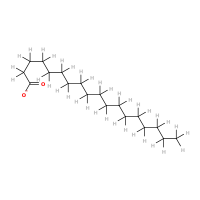
A summary of the most common chemical descriptors (InChI Key and SMILES codes) for stearate are summarized together with 3D and 2D structures and relevant physico-chemical properties.
Table of Contents
What is stearate?
The molecule stearate presents a molecular formula of C18H35O2- and its IUPAC name is octadecanoate.
3D structure
Cartesian coordinates
Geometry of stearate in x, y and z coordinates (Å units) to copy/paste elsewhere. Generated with Open Babel software.
2D drawing
Molecule descriptors
| IUPAC name | stearate |
| InChI code | InChI=1S/C18H36O2/c1-2-3-4-5-6-7-8-9-10-11-12-13-14-15-16-17-18(19)20/h2-17H2,1H3,(H,19,20)/p-1 |
| InChI Key | QIQXTHQIDYTFRH-UHFFFAOYSA-M |
| SMILES | CCCCCCCCCCCCCCCCCC(=O)[O-] |
Physico-Chemical properties
| IUPAC name | octadecanoate |
| Molecular formula | C18H35O2- |
| Molecular weight | 283.5 |
| Melting point (ºC) | |
| Boiling point (ºC) | |
| Density (g/cm3) | |
| Molar refractivity | |
| LogP | |
| Topological polar surface area | 40.1 |
LogP and topological polar surface area (TPSA) values were estimated using Open Babel software.
The n-octanol/water partition coeficient (Kow) data is applied in toxicology and drug research. Kow values are used, to guess the environmental fate of persistent organic pollutants. High partition coefficients values, tend to accumulate in the fatty tissue of organisms. Molecules with a log(Kow) (or LogP) greater than 5 are considered to bioaccumulate.
TPSA values are the sum of the surface area over all polar atoms or molecules, mainly oxygen and nitrogen, also including hydrogen atoms.
In medicinal chemistry, TPSA is used to assess the ability of a drug to permeabilise cells.
For molecules to penetrate the blood-brain barrier (and act on receptors in the central nervous system), TPSA values below 90 Å2 are required. Thus, molecules with a polar surface area greater than 140 Å2 tend to be poorly permeable to cell membranes.