
Caffeine
A summary of the most common chemical descriptors (InChI Key and SMILES codes) for Caffeine are summarized together with 3D and 2D structures and relevant physico-chemical properties.
Table of Contents
What is the Caffeine?
The molecule Caffeine presents a molecular formula of C18H19Cl2NO4 and its IUPAC name is 1,3,7-trimethylpurine-2,6-dione.
Caffeine is a naturally occurring chemical compound that belongs in a variety of plants, including coffee beans, tea leaves, cocoa beans, and kola nuts. It is the world's most widely consumed psychoactive drug and is known for its stimulating effects on the central nervous system..
Caffeine is a white, bitter, crystalline substance that is soluble in water. It is chemically classified as a xanthine alkaloid, which is a type of nitrogen-containing compound found in plants. Caffeine is structurally similar to adenine, a nucleotide that is a building block of DNA and RNA..
Caffeine is metabolized by the body in the liver and is eliminated through the kidneys. Its effects can be felt within an hour of ingestion and can last for several hours. The amount of caffeine needed to produce a stimulant effect varies from person to person and depends on factors such as age, weight, and sensitivity to caffeine..
Caffeine is commonly consumed in the form of coffee, tea, and energy drinks, as well as in some medications and supplements. It is also added to some food products, such as chocolate and certain types of chewing gum..
Caffeine is known for its ability to improve mental alertness and physical performance. It can increase heart rate, blood pressure, and blood flow to the brain, which can help improve concentration and focus. Caffeine can also enhance athletic performance by increasing the use of fat as a fuel source, which can help delay fatigue during exercise..
However, caffeine can also have negative effects on the body. Large amounts of caffeine can cause side effects such as jitters, insomnia, and increased heart rate and blood pressure. It can also lead to caffeine dependence, with withdrawal symptoms such as headache, irritability, and fatigue occurring when caffeine intake is reduced or stopped..
Summary
From all the above, this molecule is a naturally occurring chemical compound that belongs in a variety of plants. It is known for its stimulating effects on the central nervous system and is commonly consumed in the form of coffee, tea, and energy drinks. Caffeine can improve mental alertness and physical performance, but it can also have negative effects on the body when consumed in large amounts..
3D structure
Cartesian coordinates
Geometry of Caffeine in x, y and z coordinates (Å units) to copy/paste elsewhere. Generated with Open Babel software.
2D drawing
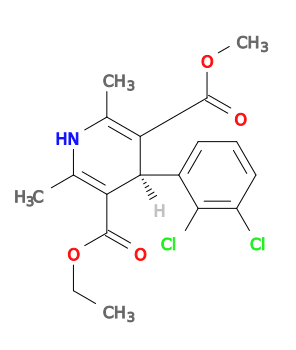
Molecule descriptors
| IUPAC name | 1,3,7-trimethylpurine-2,6-dione |
| InChI code | InChI=1S/C18H19Cl2NO4/c1-5-25-18(23)14-10(3)21-9(2)13(17(22)24-4)15(14)11-7-6-8-12(19)16(11)20/h6-8,15,21H,5H2,1-4H3/t15-/m1/s1 |
| InChI Key | RZTAMFZIAATZDJ-OAHLLOKOSA-N |
| SMILES | CCOC(=O)C1=C(C)NC(C)=C(C(=O)OC)[C@H]1c1cccc(Cl)c1Cl |
Other names (synonyms)
IUPAC nomenclature provides a standardized method for naming chemical compounds. Although this system is widely used in chemistry, many chemical compounds have also other names commonly used in different contexts. These synonyms can come from a variety of sources and are used for a variety of purposes.
One common source of synonyms for chemical compounds is the common or trivial names, assigned on the basis of appearance, properties, or origin of the molecule.
Another source of synonyms are historical or obsolete names employed in the past, however replaced nowadays by more modern or standardized names.
In addition to common and historical names, chemical compounds may also have synonyms that are specific to a particular field or industry.
- 07E4FB58-FD79-4175-8E3D-05BF96954522
- 1, 3, 7-Trimethylxanthine
- 1,3,7-Trimethyl-2,6-dioxopurine
- 1,3,7-Trimethyl-3,7-dihydro-1H-purine-2,6-dione
- 1,3,7-Trimethyl-3,7-dihydro-1H-purine-2,6-dione #
- 1,3,7-Trimethylpurine-2,6-dione
- 1,3,7-Trimethylxanthine
- 1,3,7-trimethyl-1,3,7-trihydropurine-2,6-dione
- 1,3,7-trimethyl-1H-purine-2,6(3H,7H)-dione
- 1,3,7-trimethyl-2,3,6,7-tetrahydro-1H-purine-2,6-dione
- 1,3,7-trimethyl-2,6-dioxo-1,2,3,6-tetrahydropurine
- 1,3,7-trimethyl-3,7-dihydropurine-2,6-dione
- 1,7-Trimethyl-2,6-dioxopurine
- 1,7-Trimethylxanthine
- 1-methyl-Theobromine
- 1-methyltheobromine
- 114303-55-8
- 1H-Purine-2, 3,7-dihydro-1,3,7-trimethyl-
- 1H-Purine-2,6-dione, 3,7-dihydro-1,3,7-trimethyl-
- 1gfz
- 1l5q
- 1l7x
- 2a3b
- 3,3,7-trimethyl-1H-purine-2,6-dione
- 3,7-Dihydro-1,3,7-trimethyl-1H-purin-2,6-dion
- 3,7-Dihydro-1,3,7-trimethyl-1H-purin-2,6-dion (coffein)
- 3,7-Dihydro-1,3,7-trimethyl-1H-purine-2,6-dione
- 3,7-dihydro-1,3,7-trimethyl-1H-purine
- 3,7-dihydro-1,3,7-trimethyl-1H-purine (9CI)
- 3G6A5W338E
- 3g6m
- 5-26-13-00558 (Beilstein)
- 58-08-2
- 7-Methyltheophylline
- 7-methyl Theophylline
- A.S.A. and Codeine Compound
- AB00051930-09
- AB00051930_10
- AC-12774
- ACon1_000085
- AI3-20154
- ANOQUAN COMPONENT CAFFEINE
- AS-15340
- Alert-pep
- Anacin
- Anacin Maximum Strength
- Anhydrous caffeine
- Anhydrous caffeine (JP15)
- Anhydrous caffeine (JP17)
- BDBM10849
- BIDD:ER0554
- BIDD:GT0632
- BIDD:PXR0172
- BIM-0050216.0001
- BRN 0017705
- BSPBio_001921
- Bio1_000473
- Bio1_000962
- Bio1_001451
- C 0750
- C07481
- C8H10N4O2
- CAFERGOT COMPONENT CAFFEINE
- CAFFEINE ANHYDROUS
- CAFFEINE COMPONENT OF ANOQUAN
- CAFFEINE COMPONENT OF CAFERGOT
- CAFFEINE COMPONENT OF DARVON COMPOUND
- CAFFEINE COMPONENT OF DHC PLUS
- CAFFEINE COMPONENT OF ESGIC
- CAFFEINE COMPONENT OF EXCEDRIN
- CAFFEINE COMPONENT OF FEMCET
- CAFFEINE COMPONENT OF FIORICET
- CAFFEINE COMPONENT OF FIORINAL
- CAFFEINE COMPONENT OF INVAGESIC
- CAFFEINE COMPONENT OF INVAGESIC FORTE
- CAFFEINE COMPONENT OF LANORINAL
- CAFFEINE COMPONENT OF MEDIGESIC PLUS
- CAFFEINE COMPONENT OF MIGERGOT
- CAFFEINE COMPONENT OF NORGESIC
- CAFFEINE COMPONENT OF ORPHENGESIC
- CAFFEINE COMPONENT OF ORPHENGESIC FORTE
- CAFFEINE COMPONENT OF SYNALGOS-DC
- CAFFEINE COMPONENT OF SYNALGOS-DC-A
- CAFFEINE COMPONENT OF TRIAD
- CAFFEINE COMPONENT OF WIGRAINE
- CAFFEINE-D3
- CCG-38825
- CCRIS 1314
- CFF
- CS-M0795
- CU-01000012617-3
- Cafamil
- Cafecon
- Cafeina
- Caffedrine
- Caffein
- Caffeina
- Caffeine
- Caffeine 1.0 mg/ml in Methanol
- Caffeine hydrous
- Caffeine melting point standard
- Caffeine, BioXtra
- Caffeine, anhydrous
- Caffeine, anhydrous, tested according to Ph.Eur.
- Caffeine, meets USP testing specifications, anhydrous
- Caffeine, synthetic
- Caffeinum
- Caffine
- Cafipel
- Coffein
- Coffeine
- Coffeinum
- D00528
- DARVON COMPOUND COMPONENT CAFFEINE
- DB-023002
- DB00201
- DHC PLUS COMPONENT CAFFEINE
- DHCplus
- DIMENHYDRINATE IMPURITY C
- DSSTox_CID_232
- DSSTox_GSID_20232
- DSSTox_RID_75448
- Dexitac
- DivK1c_000730
- Durvitan
- EC 200-362-1
- ESGIC COMPONENT CAFFEINE
- EU-0100228
- EXCEDRIN COMPONENT CAFFEINE
- Eldiatric C
- F3371-0262
- FEMA No. 2224
- FEMCET COMPONENT CAFFEINE
- FIORICET COMPONENT CAFFEINE
- FIORINAL COMPONENT CAFFEINE
- FT-0664195
- GTPL407
- Guaranine
- HMS1920I09
- HMS2091O11
- HMS2232M13
- HMS3260N17
- HMS3372J18
- HMS3435F10
- HMS3715D13
- HMS502E12
- HSDB 36
- Hycomine
- IDI1_000730
- INVAGESIC COMPONENT CAFFEINE
- INVAGESIC FORTE COMPONENT CAFFEINE
- KBio1_000730
- KBio2_001781
- KBio2_004349
- KBio2_006917
- KBio3_001141
- KBioGR_002325
- KBioSS_001781
- Kofein
- Koffein
- L000155
- LANORINAL COMPONENT CAFFEINE
- LP00228
- Lopac-C-0750
- Lopac0_000228
- MEDIGESIC PLUS COMPONENT CAFFEINE
- MEGxp0_001350
- MFCD00005758
- MIGERGOT COMPONENT CAFFEINE
- MLS001055341
- MLS001056714
- MLS001066409
- Mateina
- Methyltheobromide
- Methyltheobromine
- Methylxanthine theophylline
- Miudol
- MolMap_000054
- Monohydrate Caffeine
- Monomethyl derivative of Theophylline
- N1379
- N2379
- NCGC00015208-01
- NCGC00015208-02
- NCGC00015208-03
- NCGC00015208-04
- NCGC00015208-05
- NCGC00015208-06
- NCGC00015208-07
- NCGC00015208-08
- NCGC00015208-10
- NCGC00015208-11
- NCGC00015208-12
- NCGC00015208-13
- NCGC00015208-14
- NCGC00015208-15
- NCGC00015208-16
- NCGC00015208-17
- NCGC00015208-18
- NCGC00015208-20
- NCGC00015208-29
- NCGC00090699-01
- NCGC00090699-02
- NCGC00090699-03
- NCGC00090699-04
- NCGC00090699-05
- NCGC00090699-06
- NCGC00090699-07
- NCGC00090699-08
- NCGC00090699-09
- NCGC00168808-01
- NCGC00168808-02
- NCGC00254057-01
- NCGC00259234-01
- NCGC00260913-01
- NCI-C02733
- NCIOpen2_008255
- NINDS_000730
- NORGESIC COMPONENT CAFFEINE
- NSC 5036
- NSC-5036
- NSC-755917
- NSC5036
- NSC755917
- Nix Nap
- No-Doz
- NoDoz Caplets and Chewable Tablets
- Nodaca
- ORPHENGESIC COMPONENT CAFFEINE
- ORPHENGESIC FORTE COMPONENT CAFFEINE
- Organex
- P-A-C Analgesic Tablets
- PDSP1_001016
- PDSP1_001235
- PDSP2_001000
- PDSP2_001219
- Pharmakon1600-01500155
- Phensal
- Probes1_000150
- Probes2_000128
- Propoxyphene Compound 65
- Q60235
- Quick-Pep
- Refresh'n
- SBI-0050216.P004
- SDCCGMLS-0064595.P001
- SDCCGMLS-0064595.P002
- SDCCGSBI-0050216.P005
- SK 65 Compound
- SK-65 Compound
- SMR000326667
- SPECTRUM1500155
- SR-01000075187
- SR-01000075187-1
- SR-01000075187-4
- SR-01000075187-7
- SR-01000075187-8
- STK177283
- SYNALGOS-DC COMPONENT CAFFEINE
- SYNALGOS-DC-A COMPONENT CAFFEINE
- Stim
- Synalgos
- TNP00310
- TREZIX COMPONENT CAFFEINE
- TRIAD COMPONENT CAFFEINE
- Thein
- Theine
- Theine, methyltheobromine
- Theobromine Me
- Theobromine, 1-methyl-
- Theophylline Me
- Theophylline, 7-methyl
- Tirend
- Tri-Aqua
- Vivarin
- WIGRAINE COMPONENT CAFFEINE
- WLN: T56 BN DN FNVNVJ B1 F1 H1
- Xanthine, 1,3,7-trimethyl
- Xanthine,3,7-trimethyl
- Z112207564
- bmse000206
- cafeine
- caffeine
- caffeine (1,3,7-trimethylxanthine)
- caffenium
- teina
Reference codes for other databases
There exist several different chemical codes commonly used in orded to identify molecules:- CAS number (Chemical Abstracts Service Registry Number) is a unique identifier is assigned to every chemical compound indexed in the CAS database.
- Beilstein: The Beilstein database is a comprehensive source of information on organic chemistry, including information on chemical structures, properties, and reactions. The Beilstein database assigns unique identifiers which can be used to identify compounds in scientific literature and other sources.
- ChEBI (Chemical Entities of Biological Interest): ChEBI is a database of small chemical molecules that are of interest in the field of biology.
- PubChem CID (Compound Identifier): PubChem is a database of chemical compounds that is maintained by the National Institutes of Health (NIH).
- RTECS number (Registry of Toxic Effects of Chemical Substances): The RTECS is a database of information on the toxic effects of chemicals, including information on their structures and properties.
- ChEMBL (Compound Bioactivity Data): ChEMBL is a database of bioactivity data for small molecules, including information on their properties and structures.
- CompTox Dashboard (Environmental Protection Agency): The CompTox Dashboard is a database of information on the toxicology and environmental effects of chemicals.
- ZINC1084
- CAS-58-08-2
- UNII-3G6A5W338E
- AKOS000121334
- BRD-K02404261-001-02-7
- BRD-K02404261-001-03-5
- BRD-K02404261-001-07-6
- DTXSID0020232
- CHEMBL113
- CHEBI:27732
- Tox21_201685
- Tox21_300010
- Tox21_500228
- EINECS 200-362-1
- SPBio_001222
- SCHEMBL5671
- Spectrum_001301
- Spectrum2_001261
- Spectrum3_000321
- Spectrum4_001782
- Spectrum5_000423
Physico-Chemical properties
| IUPAC name | 1,3,7-trimethylpurine-2,6-dione |
| Molecular formula | C18H19Cl2NO4 |
| Molecular weight | 384.254 |
| Melting point (ºC) | |
| Boiling point (ºC) | |
| Density (g/cm3) | |
| Molar refractivity | 100.53 |
| LogP | 4.3 |
| Topological polar surface area | 64.6 |
LogP and topological polar surface area (TPSA) values were estimated using Open Babel software.
The n-octanol/water partition coeficient (Kow) data is applied in toxicology and drug research. Kow values are used, to guess the environmental fate of persistent organic pollutants. High partition coefficients values, tend to accumulate in the fatty tissue of organisms. Molecules with a log(Kow) (or LogP) greater than 5 are considered to bioaccumulate.
TPSA values are the sum of the surface area over all polar atoms or molecules, mainly oxygen and nitrogen, also including hydrogen atoms.
In medicinal chemistry, TPSA is used to assess the ability of a drug to permeabilise cells.
For molecules to penetrate the blood-brain barrier (and act on receptors in the central nervous system), TPSA values below 90 Å2 are required. Thus, molecules with a polar surface area greater than 140 Å2 tend to be poorly permeable to cell membranes.