
Thiabendazole
A summary of the most common chemical descriptors (InChI Key and SMILES codes) for Thiabendazole are summarized together with 3D and 2D structures and relevant physico-chemical properties.
Table of Contents
What is the Thiabendazole?
The molecule Thiabendazole presents a molecular formula of C10H7N3S and its IUPAC name is 4-(1H-benzimidazol-2-yl)-1,3-thiazole.
Thiabendazole (brand names Mintezol, TBZ, and others) is an antifungal medication used to treat a variety of fungal infections. It is a member of the class of drugs known as benzimidazoles..
Thiabendazole was discovered in 1962 and came into medical use in 1963. It is on the World Health Organization's List of Essential Medicines, the most effective and safe medicines needed in a health system. It exists as a generic medication..
The medication is used to treat infections caused by various species of fungi and yeasts. These include candidiasis, aspergillosis, blastomycosis, coccidioidomycosis, and histoplasmosis. It is also used to treat certain types of strongyloidiasis and trichinosis..
Thiabendazole is generally well tolerated. The most common side effects are gastrointestinal, such as nausea, vomiting, and abdominal pain. Less common side effects include headache, dizziness, and rashes. It can also cause liver damage..
Thiabendazole is contraindicated in pregnancy and in children less than two years old. It should be used with caution in people with liver disease..
The mechanism of action of thiabendazole is not fully understood. It is thought to work by inhibiting the production of ergosterol, a key component of the fungal cell membrane..
Thiabendazole was first synthesized in 1962 by scientists at Merck & Co. It was approved for medical use in the United States in 1963..
Thiabendazole is on the World Health Organization's List of Essential Medicines, the most effective and safe medicines needed in a health system..
3D structure
Cartesian coordinates
Geometry of Thiabendazole in x, y and z coordinates (Å units) to copy/paste elsewhere. Generated with Open Babel software.
2D drawing
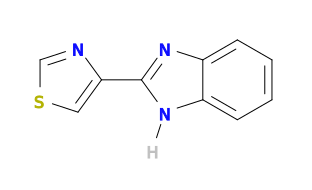
Molecule descriptors
| IUPAC name | 4-(1H-benzimidazol-2-yl)-1,3-thiazole |
| InChI code | InChI=1S/C10H7N3S/c1-2-4-8-7(3-1)12-10(13-8)9-5-14-6-11-9/h1-6H,(H,12,13) |
| InChI Key | WJCNZQLZVWNLKY-UHFFFAOYSA-N |
| SMILES | c1ccc2[nH]c(-c3cscn3)nc2c1 |
Other names (synonyms)
IUPAC nomenclature provides a standardized method for naming chemical compounds. Although this system is widely used in chemistry, many chemical compounds have also other names commonly used in different contexts. These synonyms can come from a variety of sources and are used for a variety of purposes.
One common source of synonyms for chemical compounds is the common or trivial names, assigned on the basis of appearance, properties, or origin of the molecule.
Another source of synonyms are historical or obsolete names employed in the past, however replaced nowadays by more modern or standardized names.
In addition to common and historical names, chemical compounds may also have synonyms that are specific to a particular field or industry.
- 148-79-8
- 1H-Benzimidazole, 2-(4-thiazolyl)-
- 1yvm
- 2(4-thiazolyl)-benzimidazole
- 2-(1,3-Thiazol-4-yl)-1H-benzimidazole
- 2-(1,3-Thiazol-4-yl)-1H-benzimidazole #
- 2-(1,3-Thiazol-4-yl)benzimidazole
- 2-(1,3-thiazol-4-yl)-1H-1,3-benzodiazole
- 2-(1,3-thiazol-4-yl)-1H-benzoimidazole
- 2-(1,3-thiazole-4-yl)-1H-benzimidazole
- 2-(4'-Thiazolyl)benzimidazole
- 2-(4-THIAZOLYL)-BENZIMIDAZOLE
- 2-(4-Thiazoly)-benzimidazole
- 2-(4-Thiazolyl)-1H-benzimidazole
- 2-(4-Thiazolyl)benzimidazole
- 2-(4-thiazolyl)-1h-benzoimidazole
- 2-(Thiazol-4-yl)benzimidazole
- 2-Thiazol-4-yl-1H-benzoimidazole
- 2-Thiazole-4-ylbenzimidazole
- 2-[4-Thiazoly]benzimidazole
- 4-(1H-1,3-benzodiazol-2-yl)-1,3-thiazole
- 4-(1H-Benzo[d]imidazol-2-yl)thiazole
- 4-(1H-benzimidazol-2-yl)-1,3-thiazole
- 4-(1H-benzimidazol-2-yl)thiazole
- 4-(2-Benzimidazolyl)thiazole
- 48T798
- 5-(4-Thiazolyl)benzimidazole
- 98002-42-7
- A808809
- AB00052107
- AB00052107_17
- AB00052107_18
- AC-10139
- AI3-50598
- AMY22461
- APL-luster
- Arbotect
- BCP19179
- BDBM50121347
- BIDD:ER0372
- BPBio1_000559
- BRN 0611403
- BSPBio_000507
- BSPBio_003054
- Benzimidazole, 2-(4-thiazolyl)-
- Biogard
- Bioguard
- Bovizole
- C07131
- CCG-39633
- CCRIS 4510
- CPD000058170
- Captan T
- Caswell No. 849A
- Cropasal
- Chemviron TK 100
- D00372
- DB-042952
- DB00730
- DSSTox_CID_1337
- DSSTox_GSID_21337
- DSSTox_RID_76091
- DivK1c_000072
- Drawipas
- E-Z-Ex
- E233
- E70385
- EPA Pesticide Chemical Code 060101
- Eprofil
- Equivet TZ
- Equizole
- Equizole A
- FT-0608694
- G 491
- GTPL7304
- HMS1569J09
- HMS1921E05
- HMS2092M07
- HMS2096J09
- HMS2230F20
- HMS3259E20
- HMS3372E11
- HMS3655E08
- HMS3713J09
- HMS500D14
- HSDB 2027
- HY-B0263
- Helmindrax octelmin
- Hokustar HP
- Hymush
- IDI1_000072
- KBio1_000072
- KBio2_000399
- KBio2_002967
- KBio2_005535
- KBio3_002274
- KBioGR_000787
- KBioSS_000399
- LS-07459
- Lombristop
- MFCD00005587
- MK 360
- MK-360
- MLS-0002984.P004
- MLS000053094
- MLS000069718
- Mertec
- Mertect
- Mertect 160
- Mertect 340f
- Mertect lsp
- Metasol TK 100
- Metasol TK 25
- Metasol TK-100
- Metasol tk 10
- Mintesol
- Mintezol
- Mintezole
- Minzolum
- Mycozol
- N1Q45E87DT
- NC00593
- NCGC00016410-01
- NCGC00016410-02
- NCGC00016410-03
- NCGC00016410-04
- NCGC00016410-05
- NCGC00016410-06
- NCGC00016410-07
- NCGC00016410-08
- NCGC00016410-09
- NCGC00016410-10
- NCGC00016410-11
- NCGC00016410-12
- NCGC00016410-13
- NCGC00016410-14
- NCGC00016410-15
- NCGC00016410-18
- NCGC00016410-21
- NCGC00021671-04
- NCGC00021671-05
- NCGC00021671-06
- NCGC00021671-07
- NCGC00021671-08
- NCGC00021671-09
- NCGC00021671-10
- NCGC00254873-01
- NCGC00259946-01
- NCI60_004280
- NCI60_042006
- NCIOpen2_005709
- NINDS_000072
- NSC 525040
- NSC 90507
- NSC-525040
- NSC-757347
- NSC-90507
- NSC525040
- NSC757347
- NSC90507
- Nemacin
- Nemapan
- Omnizole
- Opera_ID_336
- Ormogal
- Pharmakon1600-01500570
- Pitrizet
- Polival
- Prestwick0_000524
- Prestwick1_000524
- Prestwick2_000524
- Prestwick3_000524
- Prestwick_813
- Q424986
- RPH
- RTU Flowable Fungicide
- SBI-0051531.P003
- SDCCGMLS-0002984.P003
- SMR000058170
- SPECTRUM1500570
- SR-01000000188
- SR-01000000188-2
- SR-01000000188-4
- SR-01000000188-5
- STK394289
- SW196947-3
- Sanaizol 100
- Sistesan
- Storite
- Syntol M100
- T0830
- TBZ 6
- TBZ 60W
- TBZ-6
- Tbdz
- Tebuzate
- Tecto
- Tecto 10P
- Tecto 40F
- Tecto 60
- Tecto B
- Tecto rph
- Testo
- Thiaben
- Thiabendazol
- Thiabendazole
- Thiabendazole(usan)
- Thiabendazole, BAN, BSI, ISO, JMAF, USAN
- Thiabendazolum
- Thiabendole
- Thiabenzazole
- Thiabenzole
- Thibendole
- Thibenzol
- Thibenzole
- Thibenzole 200
- Thibenzole att
- Thiprazole
- Tiabenda
- Tiabendazol
- Tiabendazole
- Tiabendazole (JAN/INN)
- Tiabendazole, INN
- Tiabendazolum
- Tibimix 20
- Tobaz
- Top Form Wormer
- Tresaderm
- Triasox
- Tubazole
- W-108097
- WLN: T56 BM DNJ C-ET5N CSJ
- s1739
- thiabendazole
Reference codes for other databases
There exist several different chemical codes commonly used in orded to identify molecules:- CAS number (Chemical Abstracts Service Registry Number) is a unique identifier is assigned to every chemical compound indexed in the CAS database.
- Beilstein: The Beilstein database is a comprehensive source of information on organic chemistry, including information on chemical structures, properties, and reactions. The Beilstein database assigns unique identifiers which can be used to identify compounds in scientific literature and other sources.
- ChEBI (Chemical Entities of Biological Interest): ChEBI is a database of small chemical molecules that are of interest in the field of biology.
- PubChem CID (Compound Identifier): PubChem is a database of chemical compounds that is maintained by the National Institutes of Health (NIH).
- RTECS number (Registry of Toxic Effects of Chemical Substances): The RTECS is a database of information on the toxic effects of chemicals, including information on their structures and properties.
- ChEMBL (Compound Bioactivity Data): ChEMBL is a database of bioactivity data for small molecules, including information on their properties and structures.
- CompTox Dashboard (Environmental Protection Agency): The CompTox Dashboard is a database of information on the toxicology and environmental effects of chemicals.
- ZINC73711
- CAS-148-79-8
- UNII-N1Q45E87DT
- AKOS000120940
- ALBB-023635
- BRD-K77695569-001-05-2
- BRD-K77695569-001-16-9
- BRD-K77695569-001-28-4
- DTXSID0021337
- CHEMBL625
- CHEBI:45979
- Tox21_110427
- Tox21_202397
- Tox21_300970
- Tox21_110427_1
- EINECS 205-725-8
- SPBio_001481
- SPBio_002428
- SCHEMBL19842
- Spectrum_000039
- Spectrum2_001331
- Spectrum3_001407
- Spectrum4_000354
- Spectrum5_001009
Physico-Chemical properties
| IUPAC name | 4-(1H-benzimidazol-2-yl)-1,3-thiazole |
| Molecular formula | C10H7N3S |
| Molecular weight | 201.248 |
| Melting point (ºC) | |
| Boiling point (ºC) | |
| Density (g/cm3) | |
| Molar refractivity | 57.20 |
| LogP | 2.7 |
| Topological polar surface area | 69.8 |
LogP and topological polar surface area (TPSA) values were estimated using Open Babel software.
The n-octanol/water partition coeficient (Kow) data is applied in toxicology and drug research. Kow values are used, to guess the environmental fate of persistent organic pollutants. High partition coefficients values, tend to accumulate in the fatty tissue of organisms. Molecules with a log(Kow) (or LogP) greater than 5 are considered to bioaccumulate.
TPSA values are the sum of the surface area over all polar atoms or molecules, mainly oxygen and nitrogen, also including hydrogen atoms.
In medicinal chemistry, TPSA is used to assess the ability of a drug to permeabilise cells.
For molecules to penetrate the blood-brain barrier (and act on receptors in the central nervous system), TPSA values below 90 Å2 are required. Thus, molecules with a polar surface area greater than 140 Å2 tend to be poorly permeable to cell membranes.